Friday, 22 November 2013

Classics & Poverty in the Furthest North


Aberdeen, Land of the Ancient Taezali
The Alexandrian scientist Claudius Ptolemy mentioned Aberdeen (which he called 'Devonia,' from its River Dee) in about 146 BC. He said Aberdeen was inhabited by a people named the Taezalians. This week I visited their descendants. The Aberdeen University Department of Classics, founded in 1495, was abolished in 1989, just before its 500th anniversary. But enthusiasm for ancient Greece remains in The Granite City. 

This was proved by the many members of Aberdeen Scottish Hellenic Society who turned out last Tuesday, despite their first winter snowfall, to hear me lecture on Ancient Greek Minds and The Sea.

Central Court, Aberdeen Art Gallery, in 1905
The Parthenon Frieze, British MuseumThe Aberdonians have always liked Greece. In 1905 the new central court hall of the public Art Gallery was opened to display casts of ancient statues. Its inner walls were (and remain) adorned by a splendid reproduction of the Parthenon frieze, around which the building was designed. The frieze was paid for by a local philanthropist, Sir George Reid. He had made his fortune by his paintings, despite being born poor and receiving little formal education. An intellectual Leveller, he wanted everyone in Aberdeen to have access to classical sculpture.

George Reid, Beauty for Everyone
The new court was opened at a magnificent reception in April 1905. A special train arrived from Euston containing 62 guests. Among them was the writer Thomas Hardy, who, unable to attend university, had studied Greek and mythology as an apprentice stonemason. He was delighted to receive from Aberdeen University, at last, an honorary degree.

Aberdeen main
Granite Meets the North Sea in the Land of Taezalians
But Aberdeen sends out conflicting messages. In the Maritime Museum, I was appalled to learn from a display that, in 1961, 39% of Aberdonians still had no access to a household toilet. The display is intended to prove how much progress has been made, since it is paired with the news that there are now more multimillionaires in Aberdeen per head of population even than in London (it must be the oil).
Lies & Damned Statistics. There are more Poor in Aberdeen than in 1905.
Struck by these facts, by the homeless on the streets, and endless 'Pound Stores' and charity shops, I checked out the poverty statistics. The official child poverty rate in Aberdeen is today a disgraceful 23%. In 1905-6 fewer children were being raised in acute poverty--18%. 

George Reid, 'Buchanhaven Fisherman'
I don’t regard this as progress, notwithstanding the oil tycoons among the modern Taezalians. I don’t even like to speculate what the Victorian philanthropist George Reid, or Thomas Hardy, would have made of the widening gap between the rich and poor of Aberdeen in the 21st century.

Friday, 15 November 2013

What the Greeks Foresaw about The Hunger Games

Katniss: what took her so long?

I wish I was as brave as Katniss Everdeen, the reluctant protagonist of Suzanne Collins's The Hunger Games trilogy. As a mother of adolescent girls, I welcome this bow-wielding young adult female role model.  Next Friday is our long-awaited family date for the premiere of the second movie. I have already ordered the popcorn.
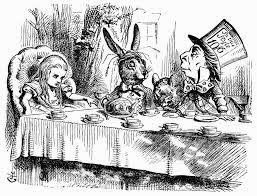
The significance of the Stoical Katniss, played with conviction by Jennifer Lawrence, cannot be over-estimated. Quest she-heroes just did not happen in the western imagination until Alice fell down the rabbit-hole to Wonderland in Lewis Carroll’s 1865 novel, followed by the more radical Dorothy in L. Frank Baum’s The Wonderful Wizard of Oz (1900). 

Dorothy: Quest Hero
Dorothy explicitly left Kansas to search for something other than a man to marry--her totemic pet dog. Baum supported Women’s Suffrage and his mother-in-law Matilda Joslyn Gage, a prominent feminist.   Yet both Alice and Dorothy were portrayed as pre-adolescent. A biological woman with a mission that had nothing to do with catching a man-for-babies took many more decades to appear.

None of this is my idea. It was in an incendiary 1985 lecture, entitled "What was Penelope unweaving?"  that American scholar Carolyn Heilbrun identified the absence of female quest heroes as preventing women from escaping the single narrative line in which they have been configured. Heilbrun showed how few narratives prepared women for entry into public life rather than the marriage market, kitchen or nursery. She identified Homer’s Penelope—static on Ithaca, bored and unfulfilled—as the figure who defines, by what she was not allowed to do, the dreadful plotline plight of womankind.

Iphigenia saves Two Big Strong Men
The ancient candidates for the status of female action- / quest-hero are few, but two exist and are both associated with the archer-goddess Artemis. One is the never-to-be-wed, intelligent and altruistic Iphigenia who in Euripides’ Iphigenia in Tauris rescues her brother Orestes, his male chum, and the “holy grail” of the cult image of Artemis. The other is Saint Thecla, who (in by far the most exciting of the apocryphal apostolic Christian Acts) tames animals in the amphitheatre, heals the sick, and dies a virgin in her nineties, successfully evading gang-rape. 

Thecla Laughs off the Lions
Sadly, who now reads that obscure tragedy by Euripides, or Acts which never made the New Testament? Perhaps the patriarchal Byzantine monks who put the finishing touches to the selection of our Classical Curriculum strategically marginalized the Artemisian Iphigenia and Thecla.    

But it is in the company of the spirits of these ancient she-heroes that I will certainly be getting inspired by Katniss at Cheltenham Cineworld next Friday.

Saturday, 9 November 2013

Aesop's Reformist Twigs v. Mussolini's Fasces


Aesop's Twig Fable Shows that Unity is Strength
A visit to the People’s History Museum in Manchester this week reminded me that, once upon a time, artistic representations of twig bundles were inspiring and wholesome.[i]  This was when illustrations of Aesop’s ancient Greek fable of the twig bundle appeared on early Trade Union banners.

Aesop's Fable the Workers' Centrepiece
The fable said that a father, worn out by the quarrels between his sons, asked them each in turn to break a tightly bound bundle of twigs. Each son failed. Then he asked them to break a single twig, a feat which they easily accomplished. The moral the father drew was that STRENGTH LIES IN UNITY.

When 19th-century workers without legal rights banded together against their employers and the state legislation to form Trade Unions, Aesop was one of the few ancient authors most of them had met. His fables were used to teach elementary literacy. Integrating an illustration of the fable into a banner was visual shorthand for ‘Unity is Strength’ and widespread, for example in these details from the 1898 banner of the Watford branches of the Worker’s Union and the Ashton & Haydon miners’ union.

Mussolini's Fascist Twig Bundle (Left)
But in 1919, the quite different—Roman—twig bundle was appropriated by Benito Mussolini’s new Partito nazionale fascista. Ancient Roman magistrates called lictors had carried their ceremonial twig bundles (fasces), bound by red tapes and with an axe protruding, to symbolise state authority and the power to punish. They had inherited the fasces from the Etruscans; many non-Fascist nations such as the US subsequently borrowed the Roman fasces long before Mussolini arrived on the scene.

The Power to Punish: Roman Fasces
So the peacable, Aesopic twigs of the British unions, who were standing up against the state, were abandoned after World War I because of the antipathy felt by members of the Trade Union movement, uniting the workers of the world, to the racism and nationalism of Fascism.  Next time you see a twig-bundle in any political iconography, ancient or modern, ask yourself whether it is a reformist bundle, derived from Aesop’s Greek fable, or an authoritarian bundle whose ancestor was once borne by a Roman magistrate. 
Table where Tom Paine wrote Rights of Man, People's History Museum


[i] My mind was on organisations set up for self-improvement since I had been invited to address the venerable ManchesterLiterary and Philosophical Society, founded in 1781 and the oldest such group in Britain, on the question of whether Classics is inherently elitist. You can read more about this visit to Manchester on Henry Stead’s blog here.