Saturday, 4 January 2014

What's In an Ancient Place-Name?


Apuleius, tried in a Sabratha court

On the radio news this morning the place-names of the two international tragedies reported as headlines sent shock-waves round my system. Near Sabratha, north-western Libya, a British man and his friend from New Zealand have been found dead. A horrible thing to happen to people who may have been visiting the ruined city there.

Sculptures on the Sabratha Theatre
It was in Sabratha, in 158 AD, that Apuleius, the author of the amazing Golden Ass, the archetypal Latin novel about the man who was turned by magic into an ass, was himself tried for witchcraft. He was accused of casting spells in order to captivate a wealthy older woman. There is little I would not give to time-travel and be present at that trial. The Sabratha theatre itself is a miracle of 3rd-century architecture, its relief sculptures offering some of the best evidence for ancient ballet dancing—‘pantomime’—in existence.

Battle of Cunaxa, near modern Fallujah
Next up was yesterday’s fall of Fallujah, west of Baghdad, to Al-Qaeda, with at least a hundred fatalities. This retrieves bitter memories of the ferocious second battle of Fallujah in 2004, with heavy losses on both US and Iraqi sides. But Fallujah also reminds any classicist of the bloody battle of nearby Cunaxa in 401, when two Persian royal brothers decimated each other’s armies, leaving Xenophon and his fellow Ten Thousand Greek mercenaries stranded, to march their way up-country (the Anabasis) to freedom.

So what difference is made by knowing the vivid ancient history of places today in the news? It is useful in that I can locate them quickly on my internal mental map. But I’m not at all sure it is useful emotionally. On the one hand it reminds me that humans have been vile to each other for all of documented history, and in some ways little has changed. On the other hand, it reminds me that we are so privileged in modernity at least to have the lost world of the ancient pagan Mediterranean to enrich our thinking about the really long view, the one that matters, into the future. 

What I have to miss because of my lager-and-front-crawl habit
Meanwhile, I have just declined an invitation to help make a film based on a Greek tragedy in Iran, specifically at the ancient seat of the Achaemenid monarchs in Persepolis. There is no reason why I should not visit Iran, except that I would last about three days in a country without being rude to someone in power because I could not drink a cold beer or splash in a Speedo! swimming costume in a pool in public. Having to say ‘no’ to such a wonderful project really does make me slightly ashamed and wish I was a better person.


Saturday, 28 December 2013

I NEED A (working-class tragic) HERO


Does a 'proper' tragic hero need a crown?

Christmas Eve brought an email inviting me to write an essay about tragedy and social class. Why did everyone in Greco-Roman antiquity and into the 19th century think tragic heroes had to ‘fall from high estate’? It was only partly because Aristotle had decreed in his Poetics that heroes should ‘have a big reputation and fortune like Oedipus and Thyestes and distinguished men from families like theirs’ [i.e. royalty].  


Modern Misery amidst Money
I have always thought myself that half the pleasure of tragedy was motored by underlying envy--watching very rich and powerful people have a really bad day offers much the same Schadenfreude to us commoners as we derive from reading about billionaires’ botched Botox and miserable divorces in celebrity-watch magazines today.


But I have a problem with this commission which I hope crowd-sourcing can help. There are a few working-class tragic heroes in the cultural repertoire. Jesus of Nazareth, on a secularist account, was the first. Born to loving parents and general applause, he ended up executed by a repressive establishment because he banged on about the poor: theologians agree that the Gospels show the influence of Greek tragedy in their structure and tone. Theatre historians, on the other hand, will tell you that the breakthrough came in 1837 with Karl Georg Büchner’s revolutionary (and unfinished) tragedy Woyzeck, which portrays its soldier-hero’s fall from a very low estate to conviction for murder.


Woyzeck, Deutsches Theater, 2009
In the projected essay I have been asked to discuss media other than theatre, and this is where my problem starts. Fiction is easy—Godwin’s Caleb Williams and Hardy’s Jude—but cinema is giving me problems. The Father Of My Children suggests Milos Forman’s One Flew Over the Cuckoo’s Nest, and I have been pondering both Trainspotting and Mike Leigh’s Naked. But inspiration is otherwise lacking.


Fall from Low Estate to ECT
If you have an idea, please do comment or send me an email  @kcl.ac.uk. If I use it you will of course be credited by name in the essay although this will certainly not make you rich and famous enough to star in a pre-19th century tragedy or even Hello! magazine. Any proposed artwork will have to fit my own general definition of tragedy: it needs to depict suffering in an aesthetically/emotionally gripping way, without voyeurism, and to enquire into the causes of that suffering. Collateral damage (to innocent people trapped to their cost in the hero’s plot) is, of course, particularly welcome.

Saturday, 21 December 2013

Think Like a Druid Week, Anyone?


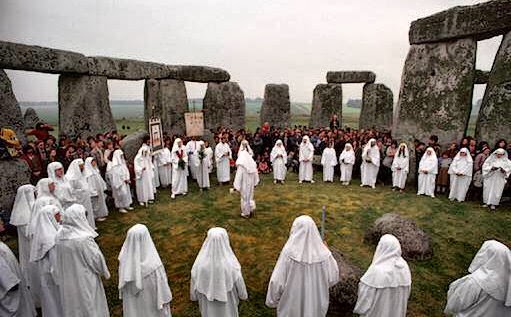
Druids at Stonehenge Solstice Rite

The winter solstice today means that it is getting ever so slightly less dark from now on. Last week was Think Like a Cynic Week but I am chewing over the idea of a Think Like a Druid week after receiving a lovely invitation.

The Rollright Stones
The tall and articulate woman who works in our village Co-op is a druidical white witch. She told me the local solstice rite, the Gorsedd, will take place after sunset at the nearby stone circle, the Rollright Stones on the Oxfordshire/Gloucestershire border.

I shouldn’t go, because it would be voyeuristic. I am not actually a pagan. My own attraction to the ancient Greeks and Romans is of the 18th-century rationalist/ Enlightenment variety. In fact, it was a terrible shock to me, at the very first class I held in my first real university job, to discover how many people like Classics just because they are witches and wizards.

Jason on the Argo Looking Pale
It was Reading University in October 1990. The class was on the Argonaut epic by Apollonius. The discussion became fixed on the spells which Medea casts in the final two books of the poem. A row erupted over the potion she has concocted from the plant growing from the blood dripping out of Prometheus’ eagle-ravaged flank. Medea had collected the sap from this plant after bathing in seven streams, putting on dark robes, and calling seven times on the Queen of the Dead.

Medea's Salve is now available online
One student said it was black magic. He could be sure because it was a spell he used personally in his capacity as Warlock of Newbury Coven. Another, hilariously called Jason, was furious: no, this was white magic, since Medea was making a protective ointment not a damaging one. He could be sure as Arch-Druid of the Reading Grove. These two youths nearly came to blows, and were only silenced by a mature student, who with righteous wrath announced she was a born-again Christian and that they were Meddling with the Works of Satan. We managed to avoid either a Manichean duel or a witch-burning session, but I was too shaken to see the funny side for weeks.


Druids in Oak Grove
White or Black Magic?
I am just old enough to have avoided compulsory Higher Education Teacher Training, which my younger colleagues now undergo. I am sure they learn useful skills. But no amount of training could ever have prepared me for that terrifying first seminar. I have tried to avoid teaching ancient magic ever since. But the Druidical lady in the Co-op is such an excellent person (she is extraordinarily well-informed on environmental issues and has bullied the whole village into bringing their own reusable shopping bags) that I must admit that the winter solstice 2013 tempts me sorely to Think Like a Druid for a while.